I was walking home on a dark, clear night in early December (the one right before COVID). I had been in the Netherlands for a couple of months; I had dived head-first into my studies, and my brain bubbled with enthusiasm for both my subject and my new country of residence. I hadn’t seen a speck of snow, meanwhile back in Canada people were brow-beaten with shovelling, and the latest scandal: photos were circulating of our Prime Minister wearing blackface. But the air in Nijmegen was merely crisp, the sidewalks were dry and sound.
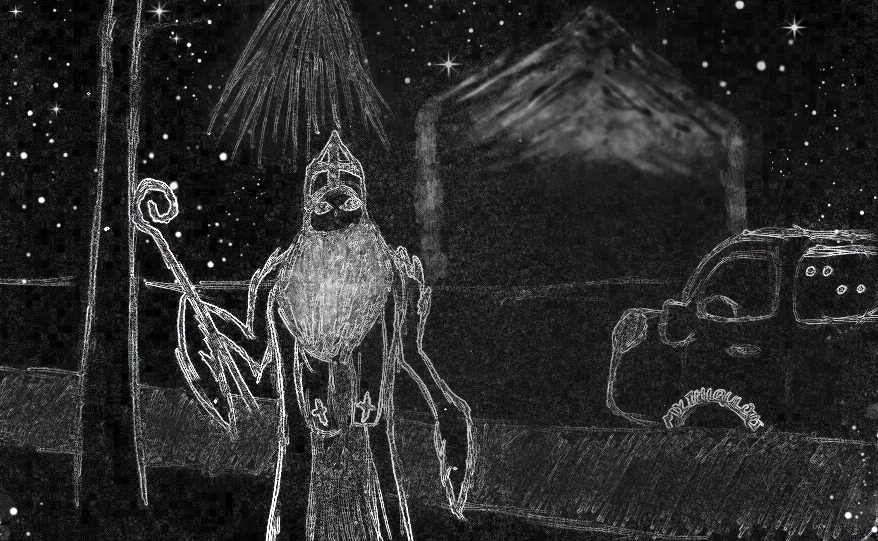
I turned a corner to begin weaving through the small streets to get to the student residency. Standing beneath a streetlamp on my route I saw a shadowed figure – the silhouette seemed eerily both familiar and foreign; I could scarcely make out the red and white clothes, and the fluffy beard that suggested Santa Claus, but something was horribly off. He wasn’t wearing a pom-pom hat. He had a bishop’s mitre on, and held a shepherd’s crook in one hand. He was gesturing at me wildly. The ruffling of his beard made it clear he was speaking. I look around. He could only have been talking to me.
I pull out my headphones, and immediately apologise; “I’m sorry, my Dutch is terrible…” and take stock of my surroundings. Still a busy street to the north, populated with enough people that there would be witnesses. There’s a car right beside us, from which I see two pairs of stark white eyes looking intently at me, but I can discern no faces to which they belong.
“Oh, English then?” – he sounds friendly enough – “Where are you from?”
“Canada,” I smile, though I did not attempt to hide my confusion.
“Do you know about Sinterklaas?” he asked, obviously hoping I did not.
Luck was on his side… “I know about Santa Claus but this is obviously not…”
I’m not sure what it was. He must have made some gesture I failed to notice, but the next moments were a frantic blur. I recall very little of what he said after that; something about horses and Spain. I was far too concerned with something else: there were indeed two men in the car. They had both exited at precisely the same time and ambushed me. I valiantly tried to try to get a look at my assailants, but they were both wearing blackface and were completely obfuscated. They were tearing at my clothes, I could hear all my zippers being pulled open, and my heart froze in my chest.
Of course the self-blaming questions started running through my head; was I wearing something that provoked this? Did they notice my Canada-leaf hat, making this a politically motivated attack related to the Prime Minister’s recent scandal? Are the hyper-(supposedly)-secular Dutch offended that I study religion and the Bishop-Santa hybrid reflects some elaborate symbolism I should recognise? Should I scream?
… It was candy. My ‘assailants’ had opened all my pockets and were stuffing them to the brim with candy. It was like a reverse mugging – and I stood there in shock while they stuffed my coat up with a coarse, cookie-like substance (I had crumbs in my coat for weeks).
___________________________________________________
These cookies, I eventually would learn, are called pepernoten. They are somewhat similar to gingerbread, but lean more towards flavours of anise, cinnamon and honey. They are one of the many Sinterklaas traditions which run parallel to Santa Claus, but are also markedly different.
Every year Sinterklaas arrives in the Netherlands 5 weeks before December 5th via boat from his homeland of Spain. During this period, every Saturday night pepernoten, other treats, and mandarins are stuffed into a shoe of every household member (though only if it contains a carrot for Sint’s horse). This feat is accomplished through his helpers, all named Piet (who may be any gender). Piets distribute the candy and collect information concerning whether children have been good or not. On December 5th itself, people (even adults) will exchange gifts (often prank or white elephant gifts), usually accompanied by terribly-written poems.
Historically the Piets are blackface characters, often with exaggerated, red-painted lips. The evolution of this character has changed dramatically over time, and I’ve heard various accounts ranging from them being enslaved black Moors, to Piet’s face merely being ‘sooty’ from traversing the chimneys of the houses he tends. Today Zwarte Piet is a topic of intense debate and consternation in the Netherlands, which has a long history of colonisation and enslavement.
And that is why I got jumped by men wearing blackface that chill December evening; not wanting to take anything from me, but to share their wealth of food and culture, neither of which I was the least bit prepared for.